Health tips
Hyperthyroidism vs Hypothyroidism: Key Differences, Symptoms, Causes and Treatment
07 November 2026
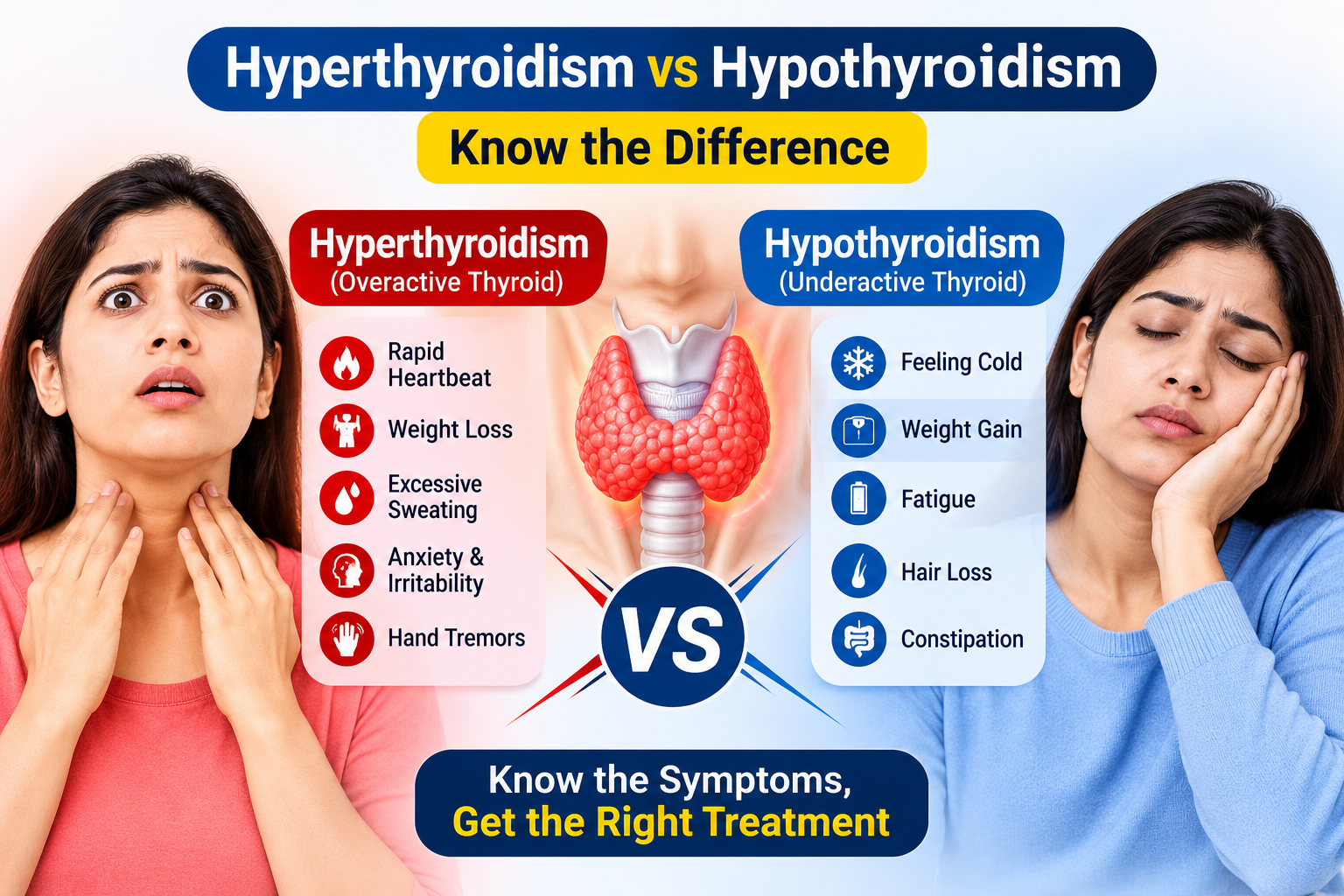
Hyperthyroidism vs Hypothyroidism: Key Differences, Symptoms, Causes and Treatment
Written for the Endocrinology team at Minerva Hospital | Medically reviewed by: [Doctor name, qualifications] | Last updated: [date]
Quick Answer: What Is the Difference?
Hypothyroidism means the thyroid gland makes too little thyroid hormone, so the body's functions slow down. Hyperthyroidism means the thyroid makes too much hormone, so the body's functions speed up. Their symptoms are largely opposite, and so are their treatments.
- Hypothyroidism: low thyroid hormone, high TSH, fatigue, weight gain, feeling cold, constipation, dry skin.
- Hyperthyroidism: high thyroid hormone, low TSH, weight loss, fast heartbeat, sweating, tremor, anxiety.
Only a blood test (TSH, Free T4, Free T3) can confirm which one you have, because some symptoms overlap and can be mild.
What Does the Thyroid Gland Do?
The thyroid is a butterfly-shaped gland at the front of the neck. It produces the hormones T3 and T4, which control your metabolism, heart rate, body temperature, digestion, mood and energy. The brain's pituitary gland monitors hormone levels and releases TSH (thyroid-stimulating hormone) to tell the thyroid to produce more or less. When this balance is disturbed in either direction, almost every organ system can be affected.
Hyperthyroidism vs Hypothyroidism: Comparison Table
| Feature | Hypothyroidism (underactive) | Hyperthyroidism (overactive) |
|---|---|---|
| Thyroid hormone (T3/T4) | Low | High |
| TSH (usually) | High | Low |
| Metabolism | Slowed | Speeded up |
| Weight | Gain or difficulty losing weight | Unintended weight loss |
| Temperature | Feels cold easily | Feels hot, excessive sweating |
| Heart rate | Slow | Fast, palpitations |
| Bowels | Constipation | Frequent or loose stools |
| Skin and hair | Dry skin, coarse hair, hair loss | Warm moist skin, thinning hair |
| Mood and sleep | Low mood, tiredness, sleeping more | Anxiety, irritability, difficulty sleeping |
| Energy | Fatigue and sluggishness | Restlessness, yet muscle weakness and fatigue |
| Menstrual cycle | Heavier or irregular periods | Lighter, infrequent or absent periods |
| Neck | Goitre possible | Goitre possible |
| Common cause | Hashimoto's thyroiditis, iodine deficiency | Graves' disease, thyroid nodules |
| Main treatment | Levothyroxine tablets | Anti-thyroid drugs, radioactive iodine, surgery |
Hypothyroidism: Symptoms and Causes
Common symptoms
- Persistent tiredness and sluggishness
- Weight gain despite eating less
- Sensitivity to cold
- Constipation
- Dry skin, brittle nails and hair loss
- Puffy face, hoarse voice
- Muscle aches and joint pain
- Low mood, poor concentration, forgetfulness
- Heavy or irregular periods
- Slow heart rate
Common causes
- Hashimoto's thyroiditis: an autoimmune condition and the most common cause
- Iodine deficiency
- Thyroid surgery or radioactive iodine treatment
- Certain medicines such as lithium or amiodarone
- Postpartum thyroiditis and congenital hypothyroidism
For patient-friendly background, see the American Thyroid Association's hypothyroidism guide.
Hyperthyroidism: Symptoms and Causes
Common symptoms
- Unexplained weight loss despite normal or increased appetite
- Rapid or irregular heartbeat, palpitations
- Excessive sweating and heat intolerance
- Tremor in the hands
- Anxiety, nervousness, irritability
- Difficulty sleeping
- Frequent bowel movements
- Lighter or missed periods
- Bulging or irritated eyes (in Graves' disease)
Common causes
- Graves' disease: an autoimmune condition and the most common cause
- Toxic nodular goitre or toxic adenoma
- Thyroiditis (temporary inflammation of the thyroid)
- Excess iodine or too much thyroid medication
You can read more in the American Thyroid Association's hyperthyroidism guide.
Which Is More Common?
Hypothyroidism is generally more common than hyperthyroidism, and both are more common in women than in men. Risk rises with age, a family history of thyroid disease, other autoimmune conditions such as type 1 diabetes, pregnancy and the postpartum period, and menopause.
Can Hypothyroidism Turn into Hyperthyroidism?
Usually the two are separate conditions, but a switch can happen in some situations:
- Over-treatment: too high a dose of levothyroxine can cause hyperthyroid symptoms, which is why regular TSH checks matter.
- Hashitoxicosis: early Hashimoto's thyroiditis can briefly release stored hormone, causing temporary hyperthyroid symptoms before hypothyroidism develops.
- After treatment of hyperthyroidism: radioactive iodine, surgery or anti-thyroid drugs can leave the thyroid underactive, requiring lifelong replacement.
- Thyroiditis: some forms, including postpartum thyroiditis, pass through an overactive phase followed by an underactive phase.
How Are They Diagnosed?
Doctors usually begin with a clinical examination and blood tests:
- TSH: the first-line screening test. It is typically high in hypothyroidism and low in hyperthyroidism.
- Free T4 and Free T3: measure active thyroid hormone in the blood.
- Anti-TPO antibodies: support a diagnosis of Hashimoto's disease.
- TSH receptor antibodies: help confirm Graves' disease.
- Thyroid ultrasound and scan: assess gland size, nodules and activity.
Reference ranges vary between laboratories, so results should always be interpreted by a doctor. Minerva Hospital offers a thyroid check-up package, and other diagnostic services are listed on the tests page.
Treatment: How Do They Differ?
Treating hypothyroidism
Treatment is usually daily levothyroxine, a synthetic thyroid hormone. The dose is adjusted by blood tests and many patients need it long term. It is normally taken on an empty stomach, and calcium, iron supplements, coffee and soy products can interfere with absorption if taken too close to the tablet.
Treating hyperthyroidism
- Anti-thyroid medicines to reduce hormone production
- Beta-blockers to control palpitations and tremor while hormone levels settle
- Radioactive iodine therapy to reduce the gland's activity
- Surgery (thyroidectomy) in selected cases, such as large goitre or suspicious nodules
⚠️ Never start, stop or change thyroid medication on your own. Wrong dosing can cause the opposite condition.
What Happens If Left Untreated?
- Untreated hypothyroidism: high cholesterol and heart disease, infertility, pregnancy complications, depression, and in rare severe cases myxoedema coma.
- Untreated hyperthyroidism: irregular heart rhythm (atrial fibrillation), heart failure, bone loss and osteoporosis, eye problems, and in rare cases thyroid storm.
Both are very treatable when detected early. For a broader overview of thyroid disease, see MedlinePlus.
When Should You See a Doctor?
Consult an endocrinologist or physician if you notice:
- Unexplained tiredness, weight change or hair loss lasting more than 2 to 3 weeks
- Palpitations, tremor, excessive sweating or anxiety
- Swelling or a lump at the front of the neck
- Irregular periods, or difficulty conceiving
- A family history of thyroid disease, or you are pregnant or planning pregnancy
Seek emergency care for severe palpitations, chest pain, breathing difficulty, confusion, or very high fever along with thyroid symptoms.
Thyroid Care at Minerva Hospital
The Diabetes and Endocrinology department at Minerva Hospital provides evaluation and long-term management of thyroid disorders, including:
- Consultation with experienced endocrinologists and physicians
- TSH, FT3, FT4 and antibody testing
- Thyroid ultrasound and FNAC
- Thyroid screening and follow-up during pregnancy
- Coordinated surgical care when needed
Frequently Asked Questions
What is the main difference between hyperthyroidism and hypothyroidism?
Hyperthyroidism is an overactive thyroid producing too much hormone, which speeds up the body. Hypothyroidism is an underactive thyroid producing too little hormone, which slows the body down.
Which is worse, hyperthyroidism or hypothyroidism?
Neither is "worse" in general. Both can cause serious complications if untreated, and both are well controlled with proper treatment. Severity depends on how high or low the hormone levels are and how long the condition has gone untreated.
Does hypothyroidism cause weight gain and hyperthyroidism weight loss?
Typically yes. Hypothyroidism slows metabolism and can cause modest weight gain, often partly from fluid retention. Hyperthyroidism speeds metabolism and commonly causes weight loss, although a few people gain weight if their appetite rises sharply.
What TSH levels indicate hypothyroidism or hyperthyroidism?
A high TSH with low Free T4 suggests hypothyroidism, while a low TSH with high Free T4 or T3 suggests hyperthyroidism. Normal ranges differ slightly between labs, so your doctor should interpret your report.
Can you have both hypothyroidism and hyperthyroidism?
Not at the same time, but a person can move from one to the other, for example during thyroiditis, after hyperthyroidism treatment, or from medication over-dosing.
Are hypothyroidism and hyperthyroidism curable?
Temporary forms such as some types of thyroiditis can resolve on their own. Autoimmune forms such as Hashimoto's and Graves' disease usually need long-term management, and most people lead normal lives with proper treatment.
Which symptoms differ most between the two?
The clearest contrasts are weight (gain versus loss), temperature tolerance (feeling cold versus hot), heart rate (slow versus fast), bowels (constipation versus loose stools) and mood (low versus anxious).
Can pregnancy be affected by thyroid problems?
Yes. Uncontrolled hypothyroidism or hyperthyroidism can affect fertility and pregnancy outcomes, but with regular monitoring and dose adjustment most women have healthy pregnancies.
Conclusion
Hyperthyroidism and hypothyroidism are opposite conditions of the same gland: one overactive, one underactive. Their symptoms can look similar to stress or everyday tiredness, so a simple blood test is the only reliable way to tell them apart. Early diagnosis and the right treatment prevent complications and restore quality of life.
Book a thyroid test and specialist consultation at Minerva Hospital today.
Disclaimer: This article is for general health awareness and is not a substitute for professional medical advice. Please consult a registered doctor for diagnosis and treatment.